Abstract
This study investigates how real-time interaction in live streaming environments drives users’ community commitment from a social affordance perspective. Drawing on Social Exchange Theory and the affordance perspective, a structural model is developed to explain how real-time interactivity facilitates parasocial interaction, promotes vicarious learning and knowledge adoption, and generates perceived benefits that ultimately lead to community commitment. Using survey data collected from 451 users of the Douyin platform and analyzed through structural equation modeling, the results provide empirical support for the proposed relationships. The findings indicate that real-time interactivity significantly enhances parasocial interaction between users and streamers, which in turn promotes both vicarious learning and knowledge adoption. These cognitive processes further generate perceived benefits, specifically hedonic benefit and self-esteem benefit, both of which positively influence users’ community commitment. Notably, self-esteem benefit shows a relatively stronger effect than hedonic benefit, indicating its greater importance in predicting sustained user engagement in live streaming communities. This study contributes to the literature by clarifying the mechanism through which social affordances are actualized in live streaming contexts and by integrating emotional and cognitive pathways to explain user commitment. It also extends prior research by positioning parasocial interaction as a key mediating mechanism linking interactive features and user outcomes. From a practical perspective, the findings provide insights for platform designers and content creators on how to enhance interactive features and develop engagement strategies that foster long-term community participation.
Keywords
Live Streaming, Social Affordances, Real-time Interaction, Parasocial Interaction, Community Commitment
1. Introduction
In recent years, live streaming has emerged as a prominent form of digital interaction and content dissemination on social media platforms. With the rapid development of mobile internet technologies and social commerce, live streaming platforms such as Douyin, Taobao Live, and Kuaishou have attracted large numbers of users worldwide. Unlike traditional online media, which primarily rely on one-way information delivery, live streaming provides a highly interactive environment where streamers and viewers can communicate in real time. Through features such as live chat, virtual gifts, emoji reactions, and fan communities, users can actively participate in the broadcasting process rather than remain passive content consumers. These interaction mechanisms create a dynamic digital environment where social relationships and community engagement can gradually emerge.
The interactive nature of live streaming platforms can be understood through the concept of social affordances, which refers to the action possibilities that technological features provide for social interaction. Within live streaming environments, technological features such as comment systems, real-time feedback, and virtual gifting offer user opportunities to express opinions, interact with streamers, and communicate with other viewers. Through these affordances, users may gradually develop emotional and cognitive connections with the streamer and the broader audience community. Previous studies have shown that these interactions can foster parasocial relationships, facilitate learning behaviors, and generate various perceived benefits for users, ultimately influencing their engagement and participation within online communities.
Despite the growing body of research on live streaming and social media interaction, few studies have systematically examined the mechanisms by which real-time interaction contributes to users’ commitment to a live streaming community. In particular, it remains unclear how interactive experiences in live streaming environments translate into cognitive outcomes, emotional benefits, and long-term community attachment. Understanding this mechanism is important for both academic research and platform management, as user commitment plays a crucial role in sustaining active communities and enhancing platform competitiveness.
To address this research gap, this study investigates how real-time interaction on live streaming platforms influences users’ community commitment from a social affordance’s perspective. Using a questionnaire survey of live-streaming users, this research constructs and empirically tests a structural model linking real-time interaction, parasocial interaction, learning processes, perceived benefits, and community commitment. By examining these relationships, the study aims to provide a clearer understanding of how social affordances are actualized in live streaming environments and how interactive experiences shape users’ psychological and behavioral engagement with online communities.
2. Literature Review
2.1. Live Streaming as an Interactive Social Environment
Live streaming has emerged as a transformative online service that integrates real-time audio and video transmission with interactive social features, fundamentally altering how content is consumed and how online communities are formed
| [1] | Jiang, C., He, L., & Xu, S. (2024). Relationships among para-social interaction, perceived benefits, community commitment, and customer citizenship behavior: Evidence from a social live-streaming platform. Acta Psychologica, 250, 104534.
https://doi.org/10.1016/j.actpsy.2024.104534 |
| [2] | Zhang, Y., Li, K., Qian, C., Li, X., & Yuan, Q. (2024). How real-time interaction and sentiment influence online sales? Understanding the role of live streaming danmaku. Journal of Retailing and Consumer Services, 78, 103793.
https://doi.org/10.1016/j.jretconser.2024.103793 |
[1, 2]
. Unlike traditional one-way video streaming, social live-streaming platforms facilitate a dynamic, bidirectional communication environment where users are not merely passive recipients of content but active participants
| [1] | Jiang, C., He, L., & Xu, S. (2024). Relationships among para-social interaction, perceived benefits, community commitment, and customer citizenship behavior: Evidence from a social live-streaming platform. Acta Psychologica, 250, 104534.
https://doi.org/10.1016/j.actpsy.2024.104534 |
| [3] | Shen, H., Zhang, Y., & Hu, Y. (2025). Immersion and behavioral intention in social media: Tiktok’s ‘travel live streaming’ perspective. Sage Open, 15(3), 21582440251367833.
https://doi.org/10.1177/21582440251367833 |
[1, 3]
. This core characteristic of real-time interaction allows for immediate engagement between streamers and viewers, creating a new type of digital social space
| [4] | He, D., Yao, Z., Tang, P., & Ma, Y. (2023). Impacts of different interactions on viewers’ sense of virtual community: an empirical study of live streaming platform. Behaviour & Information Technology, 42(7), 940-960.
https://doi.org/10.1080/0144929X.2022.2053884 |
[4]
.
The environment of a live-streaming room is rich with mechanisms designed to foster interactivity. Viewers can engage with streamers and other audience members through danmaku—real-time scrolling comments that create a shared viewing experience—as well as through liking, sharing, and sending virtual gifts
| [1] | Jiang, C., He, L., & Xu, S. (2024). Relationships among para-social interaction, perceived benefits, community commitment, and customer citizenship behavior: Evidence from a social live-streaming platform. Acta Psychologica, 250, 104534.
https://doi.org/10.1016/j.actpsy.2024.104534 |
| [2] | Zhang, Y., Li, K., Qian, C., Li, X., & Yuan, Q. (2024). How real-time interaction and sentiment influence online sales? Understanding the role of live streaming danmaku. Journal of Retailing and Consumer Services, 78, 103793.
https://doi.org/10.1016/j.jretconser.2024.103793 |
| [5] | Aw, E. C. X., Thomas, S., Patel, R., Bhatt, V., Pandey, S., & Kulkarni, P. (2025). Virtual gift donation on social live streaming platforms: insights from SEM-IPMA-ANN-NCA methods. Electronic Commerce Research, 1-37.
https://doi.org/10.1007/s10660-025-10009-z |
[1, 2, 5]
. These interactive features enable users to shape the social atmosphere, express support for streamers, and gain social recognition within the virtual space
| [1] | Jiang, C., He, L., & Xu, S. (2024). Relationships among para-social interaction, perceived benefits, community commitment, and customer citizenship behavior: Evidence from a social live-streaming platform. Acta Psychologica, 250, 104534.
https://doi.org/10.1016/j.actpsy.2024.104534 |
| [6] | Huang, Y., & Mohamad, S. H. (2025). Examining the impact of parasocial interaction and social presence on impulsive purchase in live streaming commerce context. Frontiers in Communication, 10, 1554681. https://doi.org/10.3389/fcomm.2025.1554681 |
[1, 6]
. The nature of these interactions can be further categorized into entertainment-type interactions, which activate the room’s atmosphere, and information-type interactions, focused on exchanging knowledge and evaluating products
| [2] | Zhang, Y., Li, K., Qian, C., Li, X., & Yuan, Q. (2024). How real-time interaction and sentiment influence online sales? Understanding the role of live streaming danmaku. Journal of Retailing and Consumer Services, 78, 103793.
https://doi.org/10.1016/j.jretconser.2024.103793 |
[2]
.
This active participation transforms users from bystanders into co-creators of the live streaming event. Through chatting, praising, and sending virtual gifts—digital tokens purchased with real currency—users contribute to a sense of community and shared experience
| [3] | Shen, H., Zhang, Y., & Hu, Y. (2025). Immersion and behavioral intention in social media: Tiktok’s ‘travel live streaming’ perspective. Sage Open, 15(3), 21582440251367833.
https://doi.org/10.1177/21582440251367833 |
| [5] | Aw, E. C. X., Thomas, S., Patel, R., Bhatt, V., Pandey, S., & Kulkarni, P. (2025). Virtual gift donation on social live streaming platforms: insights from SEM-IPMA-ANN-NCA methods. Electronic Commerce Research, 1-37.
https://doi.org/10.1007/s10660-025-10009-z |
[3, 5]
. The integration of e-commerce has further enriched this social environment, with live-streaming commerce becoming a significant economic force in which social interaction and commercial transactions increasingly converge
| [1] | Jiang, C., He, L., & Xu, S. (2024). Relationships among para-social interaction, perceived benefits, community commitment, and customer citizenship behavior: Evidence from a social live-streaming platform. Acta Psychologica, 250, 104534.
https://doi.org/10.1016/j.actpsy.2024.104534 |
| [2] | Zhang, Y., Li, K., Qian, C., Li, X., & Yuan, Q. (2024). How real-time interaction and sentiment influence online sales? Understanding the role of live streaming danmaku. Journal of Retailing and Consumer Services, 78, 103793.
https://doi.org/10.1016/j.jretconser.2024.103793 |
[1, 2]
. Platforms like Douyin exemplify this hybrid model, serving as spaces where entertainment, social networking, and commerce coexist and attract massive user engagement.
Empirical research confirms that these interactive features generate measurable psychological outcomes. Studies have found that social interaction in live streaming significantly predicts user immersion and satisfaction, while also fostering parasocial interaction—the illusion of intimate, friend-like relationships with streamers
| [3] | Shen, H., Zhang, Y., & Hu, Y. (2025). Immersion and behavioral intention in social media: Tiktok’s ‘travel live streaming’ perspective. Sage Open, 15(3), 21582440251367833.
https://doi.org/10.1177/21582440251367833 |
| [6] | Huang, Y., & Mohamad, S. H. (2025). Examining the impact of parasocial interaction and social presence on impulsive purchase in live streaming commerce context. Frontiers in Communication, 10, 1554681. https://doi.org/10.3389/fcomm.2025.1554681 |
[3, 6]
. These findings underscore that the interactive environment of live streaming is functionally essential for user retention and platform success. Therefore, real-time interaction can be understood as a core social affordance in live streaming environments, providing the foundation for its actualization and subsequent user engagement.
2.2. Social Affordances and Their Actualization in Digital Platforms
The concept of affordances was originally introduced by psychologist James Gibson to explain how individuals perceive possibilities for action in their environment
| [7] | Gibson, J. J. (1977). The theory of affordances. R. Shaw and J. Bransford (eds.), Perceiving, Acting and Knowing. |
[7]
. In simple terms, an affordance is what an environment “offers” an individual—what it allows them to do. A key insight from Gibson’s theory is that affordances are not fixed properties of objects; rather, they emerge from the relationship between the individual and the environment
| [8] | Roberts, J. A., & David, M. E. (2025). Technology affordances, social media engagement, and social media addiction: An investigation of Tiktok, Instagram Reels, and Youtube Shorts. Cyberpsychology, Behavior, and Social Networking, 28(5), 318-325. https://doi.org/10.1089/cyber.2024.0338 |
[8]
.
This foundational idea was later adopted in information systems research to understand how people interact with technology. In this context, IT affordances refer to the action possibilities that technological systems enable for users, depending on how users perceive and use system features to achieve their goals
. When applied to social media, researchers have developed the concept of social media affordances, defined as the goal-oriented behavioral possibilities that social media platforms offer to their users
| [10] | Jia, M., Zhao, Y. C., Song, S., Zhang, X., Wu, D., & Li, J. (2024). How vicarious learning increases users’ knowledge adoption in live streaming: The roles of parasocial interaction, social media affordances, and knowledge consensus. Information Processing & Management, 61(2), 103599.
https://doi.org/10.1016/j.ipm.2023.103599 |
[10]
. Various typologies have been proposed, including Treem and Leonardi’s four key affordances—visibility, editability, persistence, and association—and Majchrzak et al.’s affordances such as metavoicing and triggered attending in online knowledge sharing
| [11] | Treem, J. W., & Leonardi, P. M. (2013). Social media use in organizations: Exploring the affordances of visibility, editability, persistence, and association. Annals of the International Communication Association, 36(1), 143-189.
https://doi.org/10.1080/23808985.2013.11679130 |
| [12] | Majchrzak, A., Faraj, S., Kane, G. C., & Azad, B. (2013). The contradictory influence of social media affordances on online communal knowledge sharing. Journal of Computer-Mediated Communication, 19(1), 38-55.
https://doi.org/10.1111/jcc4.12030 |
[11, 12]
.
In the specific context of live streaming, researchers have identified affordances that are particularly salient. Jia et al. highlight four key affordances on platforms like TikTok and Bilibili: metavoicing (commenting, liking, sending virtual gifts), communication (real-time interaction via danmaku or video chat), browsing others’ content (observing and learning from others’ demonstrations), and relationship formation (connecting with others through fan clubs or chat rooms)
| [10] | Jia, M., Zhao, Y. C., Song, S., Zhang, X., Wu, D., & Li, J. (2024). How vicarious learning increases users’ knowledge adoption in live streaming: The roles of parasocial interaction, social media affordances, and knowledge consensus. Information Processing & Management, 61(2), 103599.
https://doi.org/10.1016/j.ipm.2023.103599 |
[10]
.
The process by which users realize these potential actions is known as actualization—turning what is possible into what is done
| [13] | Yang, Y., Chung, H. F., Elms, J., & Fletcher, P. (2025). IT affordance, organizational learning, business networking and B2B performance: A multi-channel networks perspective. Industrial Marketing Management, 129, 197-218.
https://doi.org/10.1016/j.indmarman.2025.08.001 |
[13]
. In live streaming, actualization occurs when users actively engage with platform features: sending a comment actualizes the communication affordance; joining a fan club actualizes relationship formation; scrolling through personalized recommendations actualizes recommendation accuracy and effortlessness
| [8] | Roberts, J. A., & David, M. E. (2025). Technology affordances, social media engagement, and social media addiction: An investigation of Tiktok, Instagram Reels, and Youtube Shorts. Cyberpsychology, Behavior, and Social Networking, 28(5), 318-325. https://doi.org/10.1089/cyber.2024.0338 |
| [10] | Jia, M., Zhao, Y. C., Song, S., Zhang, X., Wu, D., & Li, J. (2024). How vicarious learning increases users’ knowledge adoption in live streaming: The roles of parasocial interaction, social media affordances, and knowledge consensus. Information Processing & Management, 61(2), 103599.
https://doi.org/10.1016/j.ipm.2023.103599 |
[8, 10]
. For content creators, actualization can take strategic forms. For instance, multi-channel networks (MCNs) actualize visibility and metavoicing affordances to enhance customer engagement and drive business performance in B2B live streaming contexts
| [13] | Yang, Y., Chung, H. F., Elms, J., & Fletcher, P. (2025). IT affordance, organizational learning, business networking and B2B performance: A multi-channel networks perspective. Industrial Marketing Management, 129, 197-218.
https://doi.org/10.1016/j.indmarman.2025.08.001 |
[13]
.
Importantly, the actualization of social affordances in live streaming is what transforms passive viewers into active participants. Through actualization, users do not simply consume content; they interact, learn vicariously by observing others, form parasocial relationships with streamers, and ultimately build commitment to the community
| [10] | Jia, M., Zhao, Y. C., Song, S., Zhang, X., Wu, D., & Li, J. (2024). How vicarious learning increases users’ knowledge adoption in live streaming: The roles of parasocial interaction, social media affordances, and knowledge consensus. Information Processing & Management, 61(2), 103599.
https://doi.org/10.1016/j.ipm.2023.103599 |
[10]
. This study adopts this theoretical lens to examine how real-time interactivity, as a core social affordance, is actualized by users on platforms like Douyin, thereby triggering the cognitive and emotional processes that lead to community commitment.
2.3. Parasocial Interaction and Social Learning in Live Streaming
Horton and Wohl introduced the concept of parasocial interaction (PSI) to describe the illusory, one-sided relationships that viewers develop with media personalities
| [5] | Aw, E. C. X., Thomas, S., Patel, R., Bhatt, V., Pandey, S., & Kulkarni, P. (2025). Virtual gift donation on social live streaming platforms: insights from SEM-IPMA-ANN-NCA methods. Electronic Commerce Research, 1-37.
https://doi.org/10.1007/s10660-025-10009-z |
| [14] | Horton, D., & Richard Wohl, R. (1956). Mass communication and para-social interaction: Observations on intimacy at a distance. psychiatry, 19(3), 215-229. |
[5, 14]
. In traditional media like television, audiences often feel a sense of intimacy with performers despite the absence of real interaction. Jiang et al. characterize PSI by three features: it is illusory (a psychological experience), self-established (formed unilaterally by the viewer), and involves weak bonds (unlike strong interpersonal relationships)
| [1] | Jiang, C., He, L., & Xu, S. (2024). Relationships among para-social interaction, perceived benefits, community commitment, and customer citizenship behavior: Evidence from a social live-streaming platform. Acta Psychologica, 250, 104534.
https://doi.org/10.1016/j.actpsy.2024.104534 |
[1]
.
In live streaming, the nature of PSI has evolved significantly. Unlike traditional one-way media, live streaming platforms enable real-time, bidirectional communication through danmaku, virtual gifts, and likes, with streamers responding immediately to viewers
| [1] | Jiang, C., He, L., & Xu, S. (2024). Relationships among para-social interaction, perceived benefits, community commitment, and customer citizenship behavior: Evidence from a social live-streaming platform. Acta Psychologica, 250, 104534.
https://doi.org/10.1016/j.actpsy.2024.104534 |
| [15] | Lo, P. S., Dwivedi, Y. K., Tan, G. W. H., Ooi, K. B., Aw, E. C. X., & Metri, B. (2022). Why do consumers buy impulsively during live streaming? A deep learning-based dual-stage SEM-ANN analysis. Journal of Business Research, 147, 325-337. https://doi.org/10.1016/j.jbusres.2022.04.013 |
[1, 15]
. This interactivity creates a powerful illusion of mutual awareness and reciprocity, strengthening viewers’ emotional connection with streamers
| [6] | Huang, Y., & Mohamad, S. H. (2025). Examining the impact of parasocial interaction and social presence on impulsive purchase in live streaming commerce context. Frontiers in Communication, 10, 1554681. https://doi.org/10.3389/fcomm.2025.1554681 |
| [10] | Jia, M., Zhao, Y. C., Song, S., Zhang, X., Wu, D., & Li, J. (2024). How vicarious learning increases users’ knowledge adoption in live streaming: The roles of parasocial interaction, social media affordances, and knowledge consensus. Information Processing & Management, 61(2), 103599.
https://doi.org/10.1016/j.ipm.2023.103599 |
[6, 10]
. Research demonstrates that PSI in live streaming enhances trust and satisfaction, increases purchase intention, and drives gifting behavior through perceived benefits in relationship development and image building
| [10] | Jia, M., Zhao, Y. C., Song, S., Zhang, X., Wu, D., & Li, J. (2024). How vicarious learning increases users’ knowledge adoption in live streaming: The roles of parasocial interaction, social media affordances, and knowledge consensus. Information Processing & Management, 61(2), 103599.
https://doi.org/10.1016/j.ipm.2023.103599 |
| [15] | Lo, P. S., Dwivedi, Y. K., Tan, G. W. H., Ooi, K. B., Aw, E. C. X., & Metri, B. (2022). Why do consumers buy impulsively during live streaming? A deep learning-based dual-stage SEM-ANN analysis. Journal of Business Research, 147, 325-337. https://doi.org/10.1016/j.jbusres.2022.04.013 |
| [16] | Liu, L., Dong, Q., Wang, X., Su, C., & Zhu, M. (2025). Unpacking the link between parasocial relationships and gifting in live streaming: A mediation and moderation perspective. Journal of Retailing and Consumer Services, 87, 104436.
https://doi.org/10.1016/j.jretconser.2025.104436 |
[10, 15, 16]
. This enhanced parasocial interaction not only strengthens emotional bonds but also facilitates social learning processes, as users are more likely to observe and imitate behaviors from streamers they feel connected to.
Beyond consumption behaviors, PSI plays a crucial role in facilitating social learning. According to Social Learning Theory, individuals learn by observing others’ behaviors and their consequences
| [17] | Hao, S., & Chen, H. (2026). Streamers and viewers in live-streaming e-commerce: a social learning perspective. Management Decision, 64(1), 92-114. https://doi.org/10.1108/MD-10-2023-1978 |
| [18] | Bandura, A., & Walters, R. H. (1977). Social learning theory (Vol. 1, pp. 33-52). Englewood Cliffs, NJ: Prentice-hall. |
[17, 18]
. In live streaming, viewers engage in two forms of learning: observational learning (watching streamers’ demonstrations and others’ comments) and reinforcement learning (replicating behaviors that yield positive outcomes)
.
Hao and Chen suggest that streamers and viewers serve as distinct learning sources: learning from streamers increases certainty about product quality, demand, and streamer quality, while learning from viewers boosts product-related certainty but may reduce streamer quality certainty due to inconsistent opinions
.
In summary, PSI in live streaming has evolved into a dynamic phenomenon shaped by real-time interactivity. This enhanced PSI serves as a foundation for social learning, motivating viewers to observe and learn from both streamers and co-viewers. The interplay between PSI and social learning ultimately influences outcomes like impulsive buying, knowledge adoption, and gifting intentions
| [10] | Jia, M., Zhao, Y. C., Song, S., Zhang, X., Wu, D., & Li, J. (2024). How vicarious learning increases users’ knowledge adoption in live streaming: The roles of parasocial interaction, social media affordances, and knowledge consensus. Information Processing & Management, 61(2), 103599.
https://doi.org/10.1016/j.ipm.2023.103599 |
| [15] | Lo, P. S., Dwivedi, Y. K., Tan, G. W. H., Ooi, K. B., Aw, E. C. X., & Metri, B. (2022). Why do consumers buy impulsively during live streaming? A deep learning-based dual-stage SEM-ANN analysis. Journal of Business Research, 147, 325-337. https://doi.org/10.1016/j.jbusres.2022.04.013 |
| [16] | Liu, L., Dong, Q., Wang, X., Su, C., & Zhu, M. (2025). Unpacking the link between parasocial relationships and gifting in live streaming: A mediation and moderation perspective. Journal of Retailing and Consumer Services, 87, 104436.
https://doi.org/10.1016/j.jretconser.2025.104436 |
[10, 15, 16]
.
2.4. Perceived Benefits and Community Commitment from a Social Exchange Perspective
Social Exchange Theory (SET) provides a foundational lens for understanding why individuals engage in and sustain relationships within online communities
| [1] | Jiang, C., He, L., & Xu, S. (2024). Relationships among para-social interaction, perceived benefits, community commitment, and customer citizenship behavior: Evidence from a social live-streaming platform. Acta Psychologica, 250, 104534.
https://doi.org/10.1016/j.actpsy.2024.104534 |
[1]
. Originally developed by Homans
| [19] | Homans, G. C. (1974). Social behavior: Its elementary forms. |
[19]
and Blau
| [20] | Blau, P. M. (1964). Exchange and power in social life. |
[20]
, SET posits that human interactions are driven by subjective cost-benefit analysis and the expectation of reciprocity. Unlike economic exchanges, social exchanges involve intangible resources like emotional support and recognition
.
In live streaming, streamers invest effort and personal qualities to create engaging content, while viewers reciprocate with attention and engagement
| [21] | Giertz, J. N., Weiger, W. H., Törhönen, M., & Hamari, J. (2022). Content versus community focus in live streaming services: how to drive engagement in synchronous social media. Journal of Service Management, 33(1), 33-58.
https://doi.org/10.1108/JOSM-12-2020-0439 |
[21]
. This exchange is deeply social and emotional, as viewers seek to fulfill psychological needs and receive perceived benefits—the subjective value derived from participation
| [1] | Jiang, C., He, L., & Xu, S. (2024). Relationships among para-social interaction, perceived benefits, community commitment, and customer citizenship behavior: Evidence from a social live-streaming platform. Acta Psychologica, 250, 104534.
https://doi.org/10.1016/j.actpsy.2024.104534 |
[1]
. Prior studies suggest that perceived benefits can be categorized into social, hedonic, and self-esteem dimensions
| [22] | Kuo, Y. F., & Feng, L. H. (2013). Relationships among community interaction characteristics, perceived benefits, community commitment, and oppositional brand loyalty in online brand communities. International journal of information management, 33(6), 948-962.
https://doi.org/10.1016/j.ijinfomgt.2013.08.005 |
| [23] | Nambisan, S., & Baron, R. A. (2009). Virtual customer environments: testing a model of voluntary participation in value co‐creation activities. Journal of product innovation management, 26(4), 388-406.
https://doi.org/10.1111/j.1540-5885.2009.00667.x |
[22, 23]
. Parasocial interaction (PSI) is a key antecedent of these benefits. Jiang et al. found that PSI positively influences all three benefits, with the strongest effect on the self-esteem benefit
| [1] | Jiang, C., He, L., & Xu, S. (2024). Relationships among para-social interaction, perceived benefits, community commitment, and customer citizenship behavior: Evidence from a social live-streaming platform. Acta Psychologica, 250, 104534.
https://doi.org/10.1016/j.actpsy.2024.104534 |
[1]
.
These benefits, in turn, lead to community commitment—users’ desire to maintain a long-term relationship with the streamer and community
| [22] | Kuo, Y. F., & Feng, L. H. (2013). Relationships among community interaction characteristics, perceived benefits, community commitment, and oppositional brand loyalty in online brand communities. International journal of information management, 33(6), 948-962.
https://doi.org/10.1016/j.ijinfomgt.2013.08.005 |
[22]
. Jiang et al. found that hedonic and self-esteem benefits significantly influence community commitment, whereas social benefits did not
| [1] | Jiang, C., He, L., & Xu, S. (2024). Relationships among para-social interaction, perceived benefits, community commitment, and customer citizenship behavior: Evidence from a social live-streaming platform. Acta Psychologica, 250, 104534.
https://doi.org/10.1016/j.actpsy.2024.104534 |
[1]
. Jiang et al. show that community commitment significantly influences advocacy, helping others, and feedback, demonstrating how committed members actively contribute to value co-creation
| [1] | Jiang, C., He, L., & Xu, S. (2024). Relationships among para-social interaction, perceived benefits, community commitment, and customer citizenship behavior: Evidence from a social live-streaming platform. Acta Psychologica, 250, 104534.
https://doi.org/10.1016/j.actpsy.2024.104534 |
[1]
.
In summary, perceived benefits mediate the link between community experiences and commitment, which in turn generates reciprocal behaviors that sustain the community. This study adopts this SET lens to examine how real-time interactivity on Douyin triggers perceived benefits that lead to community commitment.
3. Research Model and Hypothesis Development
3.1. Research Model
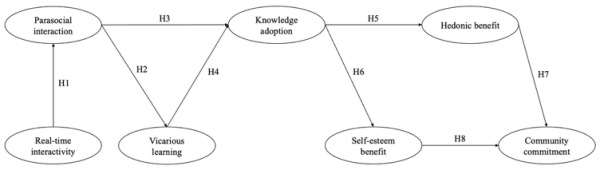
The research model of this study is shown in
Figure 1. Drawing on Social Exchange Theory and the affordance perspective, the model treats real-time interactivity as a core characteristic of live-streaming social affordances and explores its influence on users’ community commitment. Parasocial interaction is conceptualized as a mediating mechanism that facilitates social learning, including vicarious learning and knowledge adoption. These cognitive outcomes further generate two perceived benefits – hedonic benefit and self-esteem benefit, which jointly contribute to users’ behavioral outcome: commitment to the streaming community. This model explains how technological and social affordances on platforms like Douyin trigger emotional and cognitive responses that drive users’ commitment. By incorporating both emotional (parasocial ties and perceived benefits) and behavioral (interactive actions and community participation) elements, the model provides a comprehensive understanding of how live streaming platforms actualize social affordances and foster sustained user involvement.
Figure 1. The research model.
3.2. Hypothesis Development
Real-time interactivity (RTI) is a key characteristic of live streaming that enables users to engage with streamers in real time. This includes actions such as sending comments, asking questions, reacting to content with emojis, or sending virtual gifts. Such interactivity creates the impression that users are in direct contact with the streamer, even though the interaction remains one-sided. This sense of closeness and engagement forms the basis for parasocial interaction, in which users begin to perceive the streamer as a close acquaintance or even a friend
| [14] | Horton, D., & Richard Wohl, R. (1956). Mass communication and para-social interaction: Observations on intimacy at a distance. psychiatry, 19(3), 215-229. |
[14]
.
Parasocial interaction (PSI) is a psychological phenomenon in which viewers develop the illusion of a personal relationship with a media personality
. Real-time interactivity strengthens this connection, as users feel their actions (e.g., comments or gifts) directly impact the streamer and the live stream. This sense of connection has been emphasized in previous studies on social live-streaming, where interactive behaviors on platforms like TikTok have been shown to enhance emotional bonds
| [1] | Jiang, C., He, L., & Xu, S. (2024). Relationships among para-social interaction, perceived benefits, community commitment, and customer citizenship behavior: Evidence from a social live-streaming platform. Acta Psychologica, 250, 104534.
https://doi.org/10.1016/j.actpsy.2024.104534 |
[1]
. Thus, we hypothesize as follows:
H1: Real-time interactivity positively affects parasocial interaction between users and streamers.
Parasocial interaction enhances trust and emotional bonds between users and streamers. When users feel closer to the streamer, they are more likely to learn by observing their actions and behaviors. This is particularly relevant in live streaming contexts, where streamers often demonstrate specific skills, share knowledge, or showcase product usage. Users who experience parasocial interaction are more inclined toward vicarious learning, as they perceive the streamer as a credible source of information
| [4] | He, D., Yao, Z., Tang, P., & Ma, Y. (2023). Impacts of different interactions on viewers’ sense of virtual community: an empirical study of live streaming platform. Behaviour & Information Technology, 42(7), 940-960.
https://doi.org/10.1080/0144929X.2022.2053884 |
[4]
.
Knowledge adoption (KA) is the process by which users absorb and apply new knowledge from external sources. The emotional connection and trust that result from parasocial interaction encourage users to be more receptive to the streamer's knowledge. When users feel closer to a streamer, they are more likely to perceive them as an authoritative and trustworthy source of information. Thus, we hypothesize as follows:
H2: Parasocial interaction positively affects vicarious learning.
H3: Parasocial interaction positively affects knowledge adoption.
Vicarious learning (VL), based on observing the streamer’s actions, allows users to acquire knowledge and skills without direct participation. In the context of live streaming, this is particularly effective, as users can observe processes in real time and adopt them. For instance, if a streamer demonstrates how to use a particular product, users can easily absorb this information and apply it in their own lives, as observing others is a key way to acquire new information. Thus, we hypothesize as follows:
H4: Vicarious learning positively affects knowledge adoption.
Hedonic benefit (HB) refers to the enjoyment and positive emotions users derive from interacting with a product or service. In the context of live streaming, this can include both the learning process itself and the stream's entertainment aspects. That is, when users acquire new knowledge or skills through live streaming, they experience pleasure and satisfaction from the learning process. This creates a hedonic benefit associated with positive emotions and entertainment
| [22] | Kuo, Y. F., & Feng, L. H. (2013). Relationships among community interaction characteristics, perceived benefits, community commitment, and oppositional brand loyalty in online brand communities. International journal of information management, 33(6), 948-962.
https://doi.org/10.1016/j.ijinfomgt.2013.08.005 |
[22]
.
Self-esteem benefit (SE) refers to the sense of self-worth and confidence users gain from engaging with a product or service. Acquiring new knowledge and skills through live streaming enhances users’ self-esteem, making them feel more competent and confident in their abilities
| [22] | Kuo, Y. F., & Feng, L. H. (2013). Relationships among community interaction characteristics, perceived benefits, community commitment, and oppositional brand loyalty in online brand communities. International journal of information management, 33(6), 948-962.
https://doi.org/10.1016/j.ijinfomgt.2013.08.005 |
[22]
. This, in turn, strengthens their attachment to the platform and the streamer. For example, if a user learns something new through a stream, they may feel pride in their achievement. Thus, we hypothesize as follows:
H5: Knowledge adoption positively affects hedonic benefit.
H6: Knowledge adoption positively affects self-esteem benefit.
Community commitment (CC) refers to the extent to which users feel part of a community and are willing to support it. The positive emotions and enjoyment users gain from participating in live streams (i.e., hedonic benefit) strengthen their attachment to the community. As a result, they are more likely to engage in community activities, increasing their loyalty and involvement
| [22] | Kuo, Y. F., & Feng, L. H. (2013). Relationships among community interaction characteristics, perceived benefits, community commitment, and oppositional brand loyalty in online brand communities. International journal of information management, 33(6), 948-962.
https://doi.org/10.1016/j.ijinfomgt.2013.08.005 |
[22]
. For example, if users derive enjoyment from live streams, they are more likely to return to the platform and interact with other participants.
Self-esteem benefit enhances community commitment because users feel more confident and valued within the group. The boost in self-esteem and self-assurance that users gain from acquiring new knowledge encourages them to participate more actively in the community. They feel a sense of belonging and strive to maintain connections with other members. For instance, if a user gains confidence through learning in a live stream, they are more likely to share their knowledge with others in the community
| [1] | Jiang, C., He, L., & Xu, S. (2024). Relationships among para-social interaction, perceived benefits, community commitment, and customer citizenship behavior: Evidence from a social live-streaming platform. Acta Psychologica, 250, 104534.
https://doi.org/10.1016/j.actpsy.2024.104534 |
[1]
. Thus, we hypothesize as follows:
H7: Hedonic benefit positively affects community commitment.
H8: Self-esteem benefit positively affects community commitment.
4. Data Collection
The questionnaire items used in this study were adapted from prior literature and refined to fit the live-streaming context. The measurement items for real-time interactivity were adapted from Dong et al.
| [25] | Dong, X., Liu, X., & Xiao, X. (2023). Understanding the influencing mechanism of users’ participation in live streaming shopping: A socio-technical perspective. Frontiers in Psychology, 13, 1082981. https://doi.org/10.3389/fpsyg.2022.1082981 |
[25]
; parasocial interaction, vicarious learning, and knowledge adoption were adapted from Jia et al.
| [10] | Jia, M., Zhao, Y. C., Song, S., Zhang, X., Wu, D., & Li, J. (2024). How vicarious learning increases users’ knowledge adoption in live streaming: The roles of parasocial interaction, social media affordances, and knowledge consensus. Information Processing & Management, 61(2), 103599.
https://doi.org/10.1016/j.ipm.2023.103599 |
[10]
; hedonic benefit, self-esteem benefit, and community commitment were adapted from Jiang et al.
| [1] | Jiang, C., He, L., & Xu, S. (2024). Relationships among para-social interaction, perceived benefits, community commitment, and customer citizenship behavior: Evidence from a social live-streaming platform. Acta Psychologica, 250, 104534.
https://doi.org/10.1016/j.actpsy.2024.104534 |
[1]
. A five-point Likert scale was used to measure respondents’ perceptions, where 1 indicated strongly disagree, and 5 indicated strongly agree.
The questionnaire was primarily distributed to users in Mainland China, as this group represents a major user base of the Douyin platform and provides a relevant context for this study.
5. Data Analysis
This section presents the results of the quantitative analysis, including sample characteristics, reliability and validity tests, correlation analysis, and structural equation modeling.
5.1. Sample Characteristics
The survey was conducted online via the Wenjuanxing platform, targeting Douyin users across China. A total of 500 questionnaires were distributed, and 466 responses were received. After data screening, 15 responses were removed due to incompleteness or inconsistency, leaving 451 valid responses for analysis. The final sample includes users with diverse demographic characteristics and usage patterns, providing a representative basis for this study. The demographic details of the respondents are presented in
Table 1.
Table 1. Demographics of survey respondents.
| Item | Frequency | Percent (%) |
Gender | Female | 221 | 49.00% |
Male | 230 | 51.00% |
Age | Below 18 | 61 | 13.53% |
18-25 | 152 | 33.70% |
26-35 | 168 | 37.25% |
Above 36 | 70 | 15.52% |
Highest education level | High school | 69 | 15.30% |
Diploma | 171 | 37.92% |
Bachelor | 136 | 30.16% |
Master and above | 75 | 16.63% |
Occupation | Individual | 25 | 5.54% |
Enterprise personnel | 264 | 58.54% |
Civil servant | 41 | 9.09% |
Student | 99 | 21.95% |
Unemployed | 22 | 4.88% |
Monthly income | Below 2000 | 125 | 27.72% |
2001-4000 | 43 | 9.53% |
4001-6000 | 72 | 15.97% |
6001-8000 | 112 | 24.83% |
Above 8000 | 99 | 21.95% |
5.2. Reliability and Construct Validity
Reliability and validity were assessed to examine the measurement quality. As shown in
Table 2, the Cronbach’s α and composite reliability (CR) values for all constructs exceed the recommended thresholds, while the average variance extracted (AVE) values indicate adequate convergent validity.
Table 2. Reliability and validity analysis.
Construct | Item | | CR | AVE |
RTI | RTI1 | 0.870 | 0.858 | 0.602 |
| RTI2 | | | |
| RTI3 | | | |
| RTI4 | | | |
PI | PI1 | 0.882 | 0.859 | 0.549 |
| PI2 | | | |
| PI3 | | | |
| PI4 | | | |
| PI5 | | | |
VL | VL1 | 0.918 | 0.896 | 0.550 |
| VL2 | | | |
| VL3 | | | |
| VL4 | | | |
| VL5 | | | |
| VL6 | | | |
| VL7 | | | |
KA | KA1 | 0.872 | 0.841 | 0.569 |
| KA2 | | | |
| KA3 | | | |
| KA4 | | | |
HB | HB1 | 0.846 | 0.859 | 0.670 |
| HB2 | | | |
| HB3 | | | |
SE | SE1 | 0.856 | 0.849 | 0.584 |
| SE2 | | | |
| SE3 | | | |
| SE4 | | | |
CC | CC1 | 0.873 | 0.866 | 0.617 |
| CC2 | | | |
| CC3 | | | |
| CC4 | | | |
The suitability of the data for factor analysis was assessed using the KMO and Bartlett’s tests. As shown in
Table 3, the KMO value is 0.941, exceeding the recommended threshold, and Bartlett’s test of sphericity is significant (
p < 0.05), indicating that the data are appropriate for factor analysis.
Table 3. KMO & Bartlett’s test.
KMO | 0.941 |
Bartlett’s test of Sphericity | Approx. Chi-Square | 8205.866 |
df | 465 |
p | 0 |
Factor analysis was conducted using SPSS 27.0 with principal component analysis and varimax rotation. The rotated factor loadings are presented in
Table 4. All items load strongly on their respective factors, with factor loadings exceeding 0.4, indicating a clear factor structure. In addition, the item communality estimates are generally above 0.65, suggesting that the extracted factors explain a substantial proportion of the variance.
Table 4. Rotated factor loadings.
Item ID | 1 | 2 | 3 | 4 | 5 | 6 | 7 | R2 |
RTI1 | 0.13 | 0.166 | 0.091 | 0.766 | 0.158 | 0.142 | 0.09 | 0.694 |
RTI2 | 0.189 | 0.147 | 0.133 | 0.792 | 0.169 | 0.101 | 0.09 | 0.749 |
RTI3 | 0.182 | 0.151 | 0.114 | 0.787 | 0.101 | 0.123 | 0.091 | 0.721 |
RTI4 | 0.214 | 0.161 | 0.183 | 0.758 | 0.072 | 0.142 | 0.129 | 0.722 |
PI1 | 0.244 | 0.747 | 0.168 | 0.056 | 0.156 | 0.175 | 0.058 | 0.707 |
PI2 | 0.14 | 0.715 | 0.122 | 0.252 | 0.115 | 0.139 | 0.124 | 0.657 |
PI3 | 0.167 | 0.759 | 0.084 | 0.163 | 0.214 | 0.143 | 0.115 | 0.717 |
PI4 | 0.25 | 0.75 | 0.077 | 0.112 | 0.069 | 0.168 | 0.13 | 0.694 |
PI5 | 0.193 | 0.733 | 0.178 | 0.152 | 0.152 | 0.103 | 0.126 | 0.680 |
VL1 | 0.743 | 0.15 | 0.117 | 0.084 | 0.135 | 0.193 | 0.117 | 0.665 |
VL2 | 0.754 | 0.201 | 0.104 | 0.155 | 0.098 | 0.129 | 0.116 | 0.684 |
VL3 | 0.72 | 0.124 | 0.131 | 0.175 | 0.181 | 0.172 | 0.162 | 0.671 |
VL4 | 0.744 | 0.156 | 0.113 | 0.147 | 0.141 | 0.169 | 0.107 | 0.673 |
VL5 | 0.734 | 0.133 | 0.16 | 0.111 | 0.169 | 0.191 | 0.046 | 0.662 |
VL6 | 0.743 | 0.18 | 0.2 | 0.15 | 0.129 | 0.13 | 0.068 | 0.685 |
VL7 | 0.755 | 0.191 | 0.102 | 0.129 | 0.168 | 0.096 | 0.125 | 0.687 |
KA1 | 0.211 | 0.181 | 0.168 | 0.134 | 0.198 | 0.766 | 0.056 | 0.752 |
KA2 | 0.2 | 0.155 | 0.16 | 0.149 | 0.103 | 0.765 | 0.146 | 0.730 |
KA3 | 0.239 | 0.182 | 0.137 | 0.147 | 0.102 | 0.743 | 0.152 | 0.716 |
KA4 | 0.243 | 0.171 | 0.136 | 0.12 | 0.149 | 0.744 | 0.092 | 0.705 |
HB1 | 0.14 | 0.195 | 0.06 | 0.147 | 0.075 | 0.114 | 0.816 | 0.767 |
HB2 | 0.149 | 0.088 | 0.16 | 0.09 | 0.1 | 0.084 | 0.839 | 0.785 |
HB3 | 0.198 | 0.145 | 0.069 | 0.113 | 0.106 | 0.164 | 0.801 | 0.757 |
SE1 | 0.185 | 0.157 | 0.138 | 0.073 | 0.765 | 0.124 | 0.113 | 0.697 |
SE2 | 0.199 | 0.14 | 0.137 | 0.136 | 0.755 | 0.152 | 0.048 | 0.692 |
SE3 | 0.197 | 0.176 | 0.071 | 0.155 | 0.769 | 0.114 | 0.044 | 0.706 |
SE4 | 0.178 | 0.126 | 0.171 | 0.132 | 0.767 | 0.108 | 0.115 | 0.707 |
CC1 | 0.162 | 0.158 | 0.786 | 0.119 | 0.106 | 0.125 | 0.137 | 0.729 |
CC2 | 0.135 | 0.161 | 0.778 | 0.167 | 0.143 | 0.165 | 0.065 | 0.729 |
CC3 | 0.197 | 0.155 | 0.796 | 0.084 | 0.085 | 0.119 | 0.062 | 0.729 |
CC4 | 0.184 | 0.06 | 0.782 | 0.14 | 0.186 | 0.138 | 0.067 | 0.727 |
5.3. Correlation Analysis
As shown in
Table 5, all variables are significantly positively correlated (
p < 0.01), with most correlation coefficients ranging from 0.3 to 0.5, indicating moderate relationships among the constructs.
Table 5. Correlation analysis.
| Mean | Std. Dev. | RTI | PI | VL | KA | HB | SE | CC |
RTI | 3.368 | 1.101 | 1 | | | | | | |
PI | 3.417 | 1.07 | 0.469** | 1 | | | | | |
VL | 3.442 | 1.047 | 0.473** | 0.533** | 1 | | | | |
KA | 3.451 | 1.13 | 0.440** | 0.503** | 0.547** | 1 | | | |
HB | 3.292 | 1.175 | 0.356** | 0.399** | 0.406** | 0.384** | 1 | | |
SE | 3.378 | 1.078 | 0.409** | 0.461** | 0.494** | 0.441** | 0.315** | 1 | |
CC | 3.381 | 1.112 | 0.408** | 0.424** | 0.456** | 0.451** | 0.314** | 0.412** | 1 |
* p<0.05, ** p<0.01.
5.4. Structural Equation Modeling
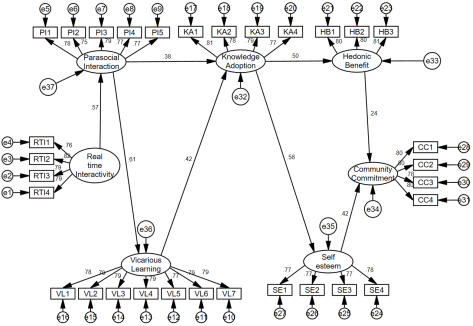
Structural equation modeling was conducted to test the proposed hypotheses, as shown in
Figure 2.
Figure 2. Structural model and hypothesis testing results.
The model fit was evaluated using multiple indices, including χ²/df, RMSEA, GFI, CFI, NFI, TLI, and IFI. As shown in
Table 6, all indices meet the recommended thresholds, indicating an acceptable model fit.
Table 6. Model fit indices.
Fit indexes | Recommendation | Structural model | Fit measures |
χ²/df | <3 | 1.633 | Acceptable |
RMSEA | <0.10 | 0.038 | Acceptable |
CFI | >0.85 | 0.966 | Acceptable |
NFI | >0.85 | 0.917 | Acceptable |
GFI | >0.85 | 0.912 | Acceptable |
TLI | >0.90 | 0.963 | Acceptable |
IFI | >0.90 | 0.966 | Acceptable |
As shown in
Table 7, real-time interactivity significantly positively affects parasocial interaction (path coefficient = 0.547,
p < 0.001), indicating that users’ real-time interactive behaviors during live streaming significantly enhance their virtual social experience with the streamer. Therefore, hypothesis H1 is supported. Parasocial interaction further significantly positively affects vicarious learning (path coefficient = 0.622,
p < 0.001), suggesting that parasocial interaction between users and streamers promotes vicarious learning, in which users acquire knowledge or skills by observing others’ behavior. Thus, hypothesis H2 is supported. At the same time, parasocial interaction also significantly positively influences knowledge adoption (path coefficient = 0.404,
p < 0.001), indicating that the interaction between users and streamers not only facilitates vicarious learning but also directly affects users’ acceptance and adoption of knowledge. Hence, hypothesis H3 is supported. Vicarious learning significantly positively affects knowledge adoption (path coefficient = 0.444,
p < 0.001), demonstrating that observing and imitating others’ behaviors significantly promote users’ acceptance and adoption of new knowledge. Therefore, hypothesis H4 is supported.
Knowledge adoption further significantly positively influences hedonic benefit (path coefficient = 0.496, p < 0.001), suggesting that after users accept and adopt new knowledge during live streaming, their hedonic experience is significantly enhanced. Thus, hypothesis H5 is supported. Knowledge adoption also significantly positively influences self-esteem benefit (path coefficient = 0.535, p < 0.001), indicating that after users accept and adopt new knowledge during live streaming, their self-esteem benefit improves. Therefore, hypothesis H6 is supported. Hedonic benefit significantly positively influences community commitment (path coefficient = 0.224, p < 0.001), suggesting that the pleasurable experience gained from live streaming significantly enhances users’ sense of community commitment. Hence, hypothesis H7 is supported. Self-esteem benefit also significantly positively influences community commitment (path coefficient = 0.424, p < 0.001), indicating that the higher users’ self-esteem benefit, the stronger their sense of belonging and commitment to the live streaming community. Therefore, hypothesis H8 is supported.
Table 7. Hypothesis testing results.
Hypothesis | Relationship | Est. | S.E. | C.R. | P | Conclusion |
H1 | RTI→PSI | 0.547 | 0.053 | 10.299 | <0.001 | Support |
H2 | PSI→VL | 0.622 | 0.055 | 11.333 | <0.001 | Support |
H3 | VL→KA | 0.444 | 0.061 | 7.328 | <0.001 | Support |
H4 | PSI→KA | 0.404 | 0.062 | 6.533 | <0.001 | Support |
H5 | KA→HB | 0.496 | 0.054 | 9.164 | <0.001 | Support |
H6 | KA→SE | 0.535 | 0.051 | 10.529 | <0.001 | Support |
H7 | SE→CC | 0.424 | 0.056 | 7.56 | <0.001 | Support |
H8 | HB→CC | 0.224 | 0.05 | 4.522 | <0.001 | Support |
6. Conclusions
This study investigates how real-time interaction in live streaming environments is translated into users’ community commitment from a social affordance perspective. Based on survey data from Douyin users and structural equation modeling, the findings provide empirical support for the proposed mechanism linking interaction, cognition, and behavioral outcomes.
The results demonstrate that real-time interactivity is a key affordance that facilitates parasocial interaction, which, in turn, promotes vicarious learning and knowledge adoption. These cognitive processes further generate perceived benefits – specifically, hedonic benefit and self-esteem benefit, which in turn drive users’ commitment to the community. Notably, self-esteem benefit shows a stronger effect on community commitment than hedonic benefit, indicating its relatively greater importance in predicting users’ sustained engagement.
This study makes several theoretical contributions. First, it extends the affordance perspective by conceptualizing real-time interactivity as a core social affordance and empirically demonstrating its actualization in live-streaming contexts. Second, it enriches the literature on parasocial interaction by positioning it as a key mediating mechanism that bridges interaction and social learning. Third, by integrating Social Exchange Theory with affordance theory, this study develops a comprehensive framework that explains how interactive experiences are transformed into perceived benefits and, ultimately, community commitment.
From a practical standpoint, the findings suggest that live streaming platforms should prioritize the design of interactive features that enhance immediacy and responsiveness, thereby strengthening users’ perceived connection with streamers. In addition, promoting content that facilitates learning and enhances users’ self-perception may further increase perceived benefits and foster sustained community engagement.
Despite these contributions, several limitations should be acknowledged. The data are limited to a single platform and a cross-sectional design, which may restrict generalizability and causal inference. Future research could adopt longitudinal or experimental designs and examine different platform contexts to further validate and extend the proposed model.
Abbreviations
RTI | Real-Time Interactivity |
PSI | Parasocial Interaction |
KA | Knowledge Adoption |
VL | Vicarious Learning |
HB | Hedonic Benefit |
SE | Self-Esteem Benefit |
CC | Community Commitment |
CR | Composite Reliability |
AVE | Average Variance Extracted |
Author Contributions
Xinjie Bong: Conceptualization, Data curation, Formal Analysis, Methodology, Project administration, Resources, Validation, Writing – original draft
Aleksandra Margushina: Conceptualization, Resources, Supervision, Visualization, Writing – review & editing
Funding
This work is not supported by any external funding.
Data Availability Statement
The data is available from the corresponding author upon reasonable request.
Conflicts of Interest
The authors declare no conflicts of interest.
References
| [1] |
Jiang, C., He, L., & Xu, S. (2024). Relationships among para-social interaction, perceived benefits, community commitment, and customer citizenship behavior: Evidence from a social live-streaming platform. Acta Psychologica, 250, 104534.
https://doi.org/10.1016/j.actpsy.2024.104534
|
| [2] |
Zhang, Y., Li, K., Qian, C., Li, X., & Yuan, Q. (2024). How real-time interaction and sentiment influence online sales? Understanding the role of live streaming danmaku. Journal of Retailing and Consumer Services, 78, 103793.
https://doi.org/10.1016/j.jretconser.2024.103793
|
| [3] |
Shen, H., Zhang, Y., & Hu, Y. (2025). Immersion and behavioral intention in social media: Tiktok’s ‘travel live streaming’ perspective. Sage Open, 15(3), 21582440251367833.
https://doi.org/10.1177/21582440251367833
|
| [4] |
He, D., Yao, Z., Tang, P., & Ma, Y. (2023). Impacts of different interactions on viewers’ sense of virtual community: an empirical study of live streaming platform. Behaviour & Information Technology, 42(7), 940-960.
https://doi.org/10.1080/0144929X.2022.2053884
|
| [5] |
Aw, E. C. X., Thomas, S., Patel, R., Bhatt, V., Pandey, S., & Kulkarni, P. (2025). Virtual gift donation on social live streaming platforms: insights from SEM-IPMA-ANN-NCA methods. Electronic Commerce Research, 1-37.
https://doi.org/10.1007/s10660-025-10009-z
|
| [6] |
Huang, Y., & Mohamad, S. H. (2025). Examining the impact of parasocial interaction and social presence on impulsive purchase in live streaming commerce context. Frontiers in Communication, 10, 1554681.
https://doi.org/10.3389/fcomm.2025.1554681
|
| [7] |
Gibson, J. J. (1977). The theory of affordances. R. Shaw and J. Bransford (eds.), Perceiving, Acting and Knowing.
|
| [8] |
Roberts, J. A., & David, M. E. (2025). Technology affordances, social media engagement, and social media addiction: An investigation of Tiktok, Instagram Reels, and Youtube Shorts. Cyberpsychology, Behavior, and Social Networking, 28(5), 318-325.
https://doi.org/10.1089/cyber.2024.0338
|
| [9] |
Volkoff, O., & Strong, D. M. (2013). Critical realism and affordances: theorizing IT-associated organizational change processes1. MIS quarterly, 37(3), 819-834.
https://doi.org/10.25300/MISQ/2013/37.3.07
|
| [10] |
Jia, M., Zhao, Y. C., Song, S., Zhang, X., Wu, D., & Li, J. (2024). How vicarious learning increases users’ knowledge adoption in live streaming: The roles of parasocial interaction, social media affordances, and knowledge consensus. Information Processing & Management, 61(2), 103599.
https://doi.org/10.1016/j.ipm.2023.103599
|
| [11] |
Treem, J. W., & Leonardi, P. M. (2013). Social media use in organizations: Exploring the affordances of visibility, editability, persistence, and association. Annals of the International Communication Association, 36(1), 143-189.
https://doi.org/10.1080/23808985.2013.11679130
|
| [12] |
Majchrzak, A., Faraj, S., Kane, G. C., & Azad, B. (2013). The contradictory influence of social media affordances on online communal knowledge sharing. Journal of Computer-Mediated Communication, 19(1), 38-55.
https://doi.org/10.1111/jcc4.12030
|
| [13] |
Yang, Y., Chung, H. F., Elms, J., & Fletcher, P. (2025). IT affordance, organizational learning, business networking and B2B performance: A multi-channel networks perspective. Industrial Marketing Management, 129, 197-218.
https://doi.org/10.1016/j.indmarman.2025.08.001
|
| [14] |
Horton, D., & Richard Wohl, R. (1956). Mass communication and para-social interaction: Observations on intimacy at a distance. psychiatry, 19(3), 215-229.
|
| [15] |
Lo, P. S., Dwivedi, Y. K., Tan, G. W. H., Ooi, K. B., Aw, E. C. X., & Metri, B. (2022). Why do consumers buy impulsively during live streaming? A deep learning-based dual-stage SEM-ANN analysis. Journal of Business Research, 147, 325-337.
https://doi.org/10.1016/j.jbusres.2022.04.013
|
| [16] |
Liu, L., Dong, Q., Wang, X., Su, C., & Zhu, M. (2025). Unpacking the link between parasocial relationships and gifting in live streaming: A mediation and moderation perspective. Journal of Retailing and Consumer Services, 87, 104436.
https://doi.org/10.1016/j.jretconser.2025.104436
|
| [17] |
Hao, S., & Chen, H. (2026). Streamers and viewers in live-streaming e-commerce: a social learning perspective. Management Decision, 64(1), 92-114.
https://doi.org/10.1108/MD-10-2023-1978
|
| [18] |
Bandura, A., & Walters, R. H. (1977). Social learning theory (Vol. 1, pp. 33-52). Englewood Cliffs, NJ: Prentice-hall.
|
| [19] |
Homans, G. C. (1974). Social behavior: Its elementary forms.
|
| [20] |
Blau, P. M. (1964). Exchange and power in social life.
|
| [21] |
Giertz, J. N., Weiger, W. H., Törhönen, M., & Hamari, J. (2022). Content versus community focus in live streaming services: how to drive engagement in synchronous social media. Journal of Service Management, 33(1), 33-58.
https://doi.org/10.1108/JOSM-12-2020-0439
|
| [22] |
Kuo, Y. F., & Feng, L. H. (2013). Relationships among community interaction characteristics, perceived benefits, community commitment, and oppositional brand loyalty in online brand communities. International journal of information management, 33(6), 948-962.
https://doi.org/10.1016/j.ijinfomgt.2013.08.005
|
| [23] |
Nambisan, S., & Baron, R. A. (2009). Virtual customer environments: testing a model of voluntary participation in value co‐creation activities. Journal of product innovation management, 26(4), 388-406.
https://doi.org/10.1111/j.1540-5885.2009.00667.x
|
| [24] |
Giles, D. C. (2002). Parasocial interaction: A review of the literature and a model for future research. Media psychology, 4(3), 279-305.
https://doi.org/10.1207/S1532785XMEP0403_04
|
| [25] |
Dong, X., Liu, X., & Xiao, X. (2023). Understanding the influencing mechanism of users’ participation in live streaming shopping: A socio-technical perspective. Frontiers in Psychology, 13, 1082981.
https://doi.org/10.3389/fpsyg.2022.1082981
|
Cite This Article
-
APA Style
Bong, X., Margushina, A. (2026). Actualizing Social Affordances in Live Streaming:
The Role of Real-Time Interaction in Building Community Commitment. International Journal of Economics, Finance and Management Sciences, 14(2), 161-172. https://doi.org/10.11648/j.ijefm.20261402.15
 Copy
|
Copy
|
 Download
ACS Style
Bong, X.; Margushina, A. Actualizing Social Affordances in Live Streaming:
The Role of Real-Time Interaction in Building Community Commitment. Int. J. Econ. Finance Manag. Sci. 2026, 14(2), 161-172. doi: 10.11648/j.ijefm.20261402.15
Copy
|
Download
AMA Style
Bong X, Margushina A. Actualizing Social Affordances in Live Streaming:
The Role of Real-Time Interaction in Building Community Commitment. Int J Econ Finance Manag Sci. 2026;14(2):161-172. doi: 10.11648/j.ijefm.20261402.15
Copy
|
Download
-
@article{10.11648/j.ijefm.20261402.15,
  author = {Xinjie Bong and Aleksandra Margushina},
  title = {Actualizing Social Affordances in Live Streaming:
The Role of Real-Time Interaction in Building Community Commitment},
  journal = {International Journal of Economics, Finance and Management Sciences},
  volume = {14},
  number = {2},
  pages = {161-172},
  doi = {10.11648/j.ijefm.20261402.15},
  url = {https://doi.org/10.11648/j.ijefm.20261402.15},
  eprint = {https://article.sciencepublishinggroup.com/pdf/10.11648.j.ijefm.20261402.15},
  abstract = {This study investigates how real-time interaction in live streaming environments drives users’ community commitment from a social affordance perspective. Drawing on Social Exchange Theory and the affordance perspective, a structural model is developed to explain how real-time interactivity facilitates parasocial interaction, promotes vicarious learning and knowledge adoption, and generates perceived benefits that ultimately lead to community commitment. Using survey data collected from 451 users of the Douyin platform and analyzed through structural equation modeling, the results provide empirical support for the proposed relationships. The findings indicate that real-time interactivity significantly enhances parasocial interaction between users and streamers, which in turn promotes both vicarious learning and knowledge adoption. These cognitive processes further generate perceived benefits, specifically hedonic benefit and self-esteem benefit, both of which positively influence users’ community commitment. Notably, self-esteem benefit shows a relatively stronger effect than hedonic benefit, indicating its greater importance in predicting sustained user engagement in live streaming communities. This study contributes to the literature by clarifying the mechanism through which social affordances are actualized in live streaming contexts and by integrating emotional and cognitive pathways to explain user commitment. It also extends prior research by positioning parasocial interaction as a key mediating mechanism linking interactive features and user outcomes. From a practical perspective, the findings provide insights for platform designers and content creators on how to enhance interactive features and develop engagement strategies that foster long-term community participation.},
 year = {2026}
}
Copy
|
Download
-
TY  - JOUR
T1  - Actualizing Social Affordances in Live Streaming:
The Role of Real-Time Interaction in Building Community Commitment
AU  - Xinjie Bong
AU  - Aleksandra Margushina
Y1  - 2026/04/21
PY  - 2026
N1  - https://doi.org/10.11648/j.ijefm.20261402.15
DO  - 10.11648/j.ijefm.20261402.15
T2  - International Journal of Economics, Finance and Management Sciences
JF  - International Journal of Economics, Finance and Management Sciences
JO  - International Journal of Economics, Finance and Management Sciences
SP  - 161
EP  - 172
PB  - Science Publishing Group
SN  - 2326-9561
UR  - https://doi.org/10.11648/j.ijefm.20261402.15
AB  - This study investigates how real-time interaction in live streaming environments drives users’ community commitment from a social affordance perspective. Drawing on Social Exchange Theory and the affordance perspective, a structural model is developed to explain how real-time interactivity facilitates parasocial interaction, promotes vicarious learning and knowledge adoption, and generates perceived benefits that ultimately lead to community commitment. Using survey data collected from 451 users of the Douyin platform and analyzed through structural equation modeling, the results provide empirical support for the proposed relationships. The findings indicate that real-time interactivity significantly enhances parasocial interaction between users and streamers, which in turn promotes both vicarious learning and knowledge adoption. These cognitive processes further generate perceived benefits, specifically hedonic benefit and self-esteem benefit, both of which positively influence users’ community commitment. Notably, self-esteem benefit shows a relatively stronger effect than hedonic benefit, indicating its greater importance in predicting sustained user engagement in live streaming communities. This study contributes to the literature by clarifying the mechanism through which social affordances are actualized in live streaming contexts and by integrating emotional and cognitive pathways to explain user commitment. It also extends prior research by positioning parasocial interaction as a key mediating mechanism linking interactive features and user outcomes. From a practical perspective, the findings provide insights for platform designers and content creators on how to enhance interactive features and develop engagement strategies that foster long-term community participation.
VL  - 14
IS  - 2
ER  -
Copy
|
Download





 Share This Article
 Twitter
 Linked In
 Facebook